Issue 30: The End of Stock Scarcity
For 23 years America was running out of shares, and that shrinking float quietly held the market up. This year it reverses.


For twenty-three years, America has been running out of shares.
Not out of companies. Out of the stock those companies have on offer. Buybacks retired it, cash acquisitions absorbed it, and a generation of businesses stayed private rather than listing, so the supply of public equity shrank in almost every year since 2003. That shrinking float quietly did some of the work that earnings are supposed to do.
Barclays expects 2026 to be the year it turns, with roughly 1.5 trillion dollars of net new stock arriving over the next two years.
The largest companies in the world are now selling the same thing every private company is selling.
One story this week, our first issuer spotlight, something new for founders, and a note from the road at the end.
The End of Stock Scarcity
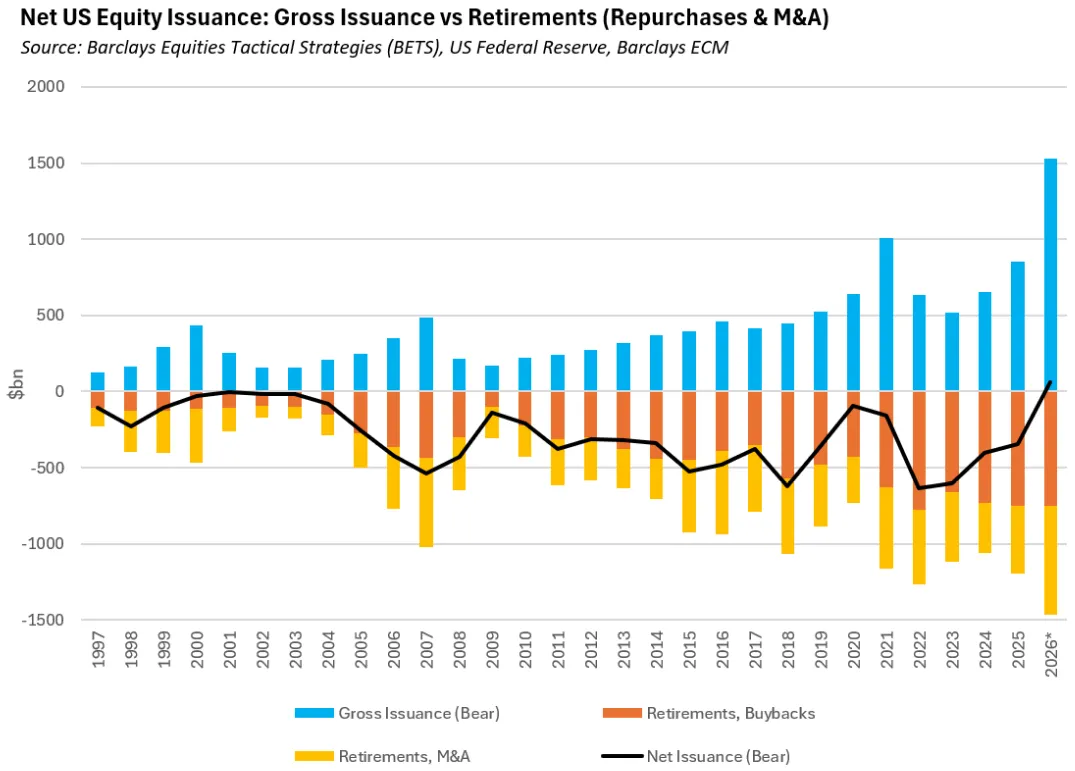
The chart above is the whole argument. In every year the net line sits below zero, the market ended up holding less stock than it started with, and that arithmetic supported prices without anyone deciding it should. In 2026 it crosses.
What changed is a financing decision at four companies. Alphabet, Amazon, Meta and Microsoft have announced something like 725 billion dollars of combined spending on AI infrastructure, and that money has to come from somewhere. Alphabet's free cash flow went negative last quarter for the first time since it went public, and Meta's fell to 784 million dollars, its lowest in nearly four years. They are not selling stock because they want to.
The bond market is not making it easier. The thirty-year Treasury has traded above five percent for twenty-seven days this year, about one session in five, and the last time it spent that long up there was 2007.
Now set that against the other end of the market. The Census Bureau counted 5.62 million applications to start new businesses last year, and only about three in ten of them expect to ever employ anyone besides the founder. There is more equity arriving at the top, more companies forming at the bottom, and the machinery in the middle did not get any wider.
Which is a problem if you are one of the companies in the middle, and it is the reason the rest of this issue is about what to do about it.
Read the full Barclays breakdown.
Issuer Spotlight: Neural AI

This month's Issuer Spotlight is Neural AI, the Autonomic Intelligence company founded by Charlie Schoenhoeft, whose raise we packaged this summer. It builds intelligent applications in hardware that learn, recognize, and decide in real time, from the core to the edge.
What stood out was precision: the team was exact about what is built, what is in development, and what is still ahead, which is what carries an offering through diligence. Its new site, neuralai.ai, now shares one front door with our materials.
Neural AI is conducting a general solicitation offering under Rule 506(c) of Regulation D, open to verified accredited investors only. If you are a verified accredited investor and want to learn more, the Company's page on the platform is here: Neural AI on Deal Box.
As always: Deal Box is not a broker-dealer and does not recommend any investment. We are compensated by issuers for technology and advisory services only, never on transactions. Nothing in this Spotlight is an offer, a solicitation, or investment advice; any offer is made only through the Company's offering documents.
Two ways in
Raising, or know someone who is? Build a branded investor portal from the deck you already have, free, and keep the whole round. If someone you know is raising, forward them this issue. Start free.
Investing as an accredited investor? See what is live on the platform. Verification runs first, before any offering materials are available. Get started.
(Deal Box operates as a Title II matchmaking platform under the JOBS Act Section 201(c) exemption. We charge issuers for technology and advisory services and take no transaction fees from anyone. We are not a broker-dealer.)
How to raise from accredited investors

Your dentist is probably an accredited investor. So are the couple who own three franchise locations across town, and the regional sales director who has been maxing out a 401k since the nineties.
About 24.3 million American households qualified in 2022, roughly 18.5 percent of all of them, against 1.5 million households in 1983. The rule itself never changed. The thresholds were never indexed to inflation, so four decades of wage and asset growth carried a fifth of the country across a line that had been drawn for the wealthy.
We wrote the practical playbook for reaching them, from who actually qualifies to the pipeline that closes the round.
One More Thing
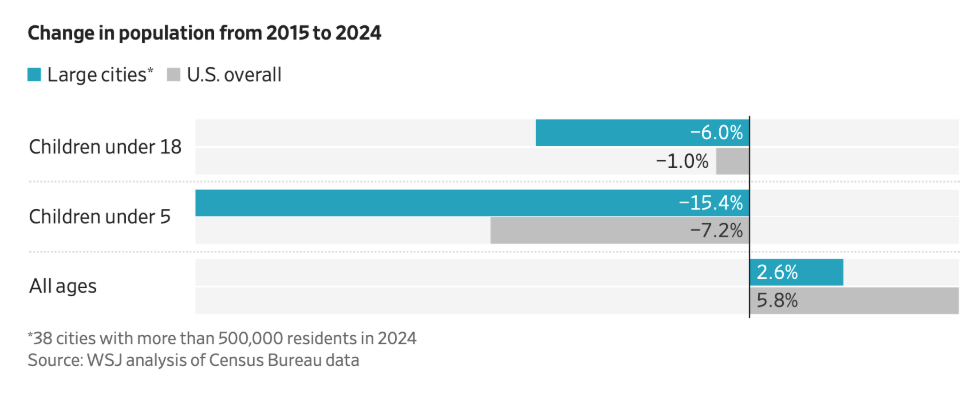
The Census Bureau counts more than new businesses. Between 2015 and 2024 the number of children under eighteen in large American cities fell six percent, against one percent nationwide. Under age five it fell fifteen percent. San Jose lost twenty percent of its children, Los Angeles sixteen, and Chicago thirteen. This is not only an American story either, and Japan recorded fewer births in 2024 than it did in 1873.
My take: every valuation ends in a terminal value, and every terminal value quietly assumes somebody is still there to buy the thing. :-)
The Latest in Private Markets
- The forced seller nobody priced in. An AI fund that turned 225 million dollars into 45 billion in under two years was margin called by its three prime brokers and sold its entire public stock book to Citadel in a single block trade before Thursday's open. The only position that survived was the private one, because private stakes cannot be margin called. (CNBC)
- Credit asks the question first. Five-year protection on Oracle debt has run to roughly double where it started the year, against 144 basis points in January, and protection on Nvidia set a record this month. Spreads move before multiples do. (CNBC)
- The plumbing went on-chain. DTCC began production trades of tokenized stocks and Treasuries on July 15 with about forty firms including JPMorgan, BlackRock and Goldman, with a full launch targeted for October. Tokenization stops being a thesis the moment the clearinghouse starts doing it. (DTCC)
A note from the road

I have been on the mainland this week rather than at my desk in Honolulu, sitting down with people we have worked alongside for years and with the wider Deal Box team in person.
Video calls are efficient and they are not the same thing. You learn more about where somebody actually stands in the first ten minutes across a table than in a month of scheduled calls! It was a good reminder that this business runs on relationships that were built long before anyone needed anything.
Thank you for reading, as always.
More to come next Friday.
Best,
Thomas
On the road | July 31, 2026

The Deal Box Dispatch is published weekly every Friday. Deal Box operates as a Title II matchmaking platform under the JOBS Act Section 201(c) exemption, with zero transaction fees. We are not a broker-dealer. We earn on technology and advisory services provided to issuers only. Nothing in this newsletter is a recommendation, solicitation, or offer to buy or sell any security.