Issue 31: Twice as Fast as the Housing Boom
Data-center investment is climbing at nearly twice the speed of the housing boom at its peak. Torsten Slok's numbers on the fastest capex cycle in modern history, the intervention that showed where the Treasury market's ceiling is, and what horse racing teaches about the wisdom of crowds.


Data-center investment is on track to go from 1.4 percent of GDP to 3.1 percent in two years. That number comes from Torsten Slok, Apollo's chief economist, and the comparison he attaches to it is the one worth sitting with. The housing boom, at its absolute fastest, added half a percentage point of GDP per year. The AI buildout is adding 0.85.
Nothing in modern American capex has moved at this speed. Not housing before 2008, and not telecom before the fiber bust in 2001.
Twice as Fast as the Housing Boom
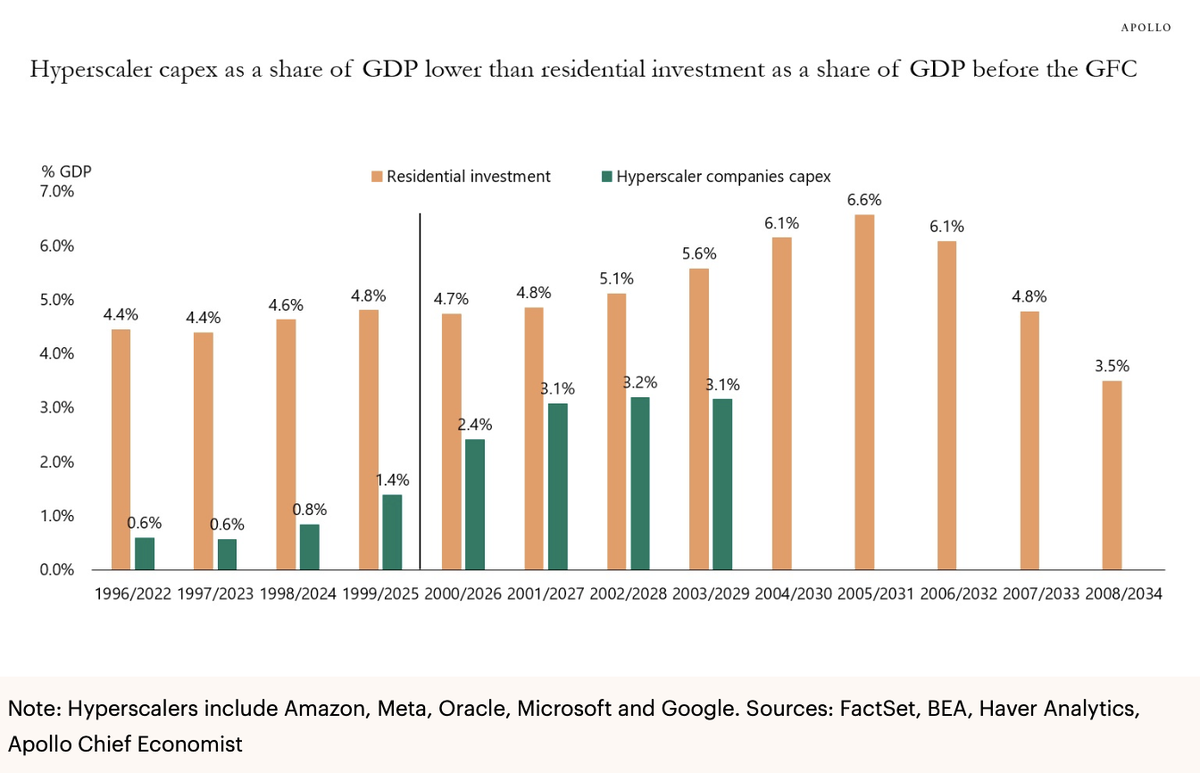
The comforting read of the chart above is the height of the bars. Housing peaked at 6.6 percent of GDP before the financial crisis. Hyperscaler capex is forecast to top out near 3.2 percent, less than half that. If the level were the whole story, the AI buildout would be a medium-sized cycle and everyone could relax.
Slok's argument is that data-center spending is on track to more than double its share of the economy in just two years, from 1.4 percent of GDP to 3.1. The housing boom at its absolute fastest climbed half as quickly. The fiber buildout of the late nineties moved at a sixth of this pace. In plain terms, America has never poured money into one thing this fast.
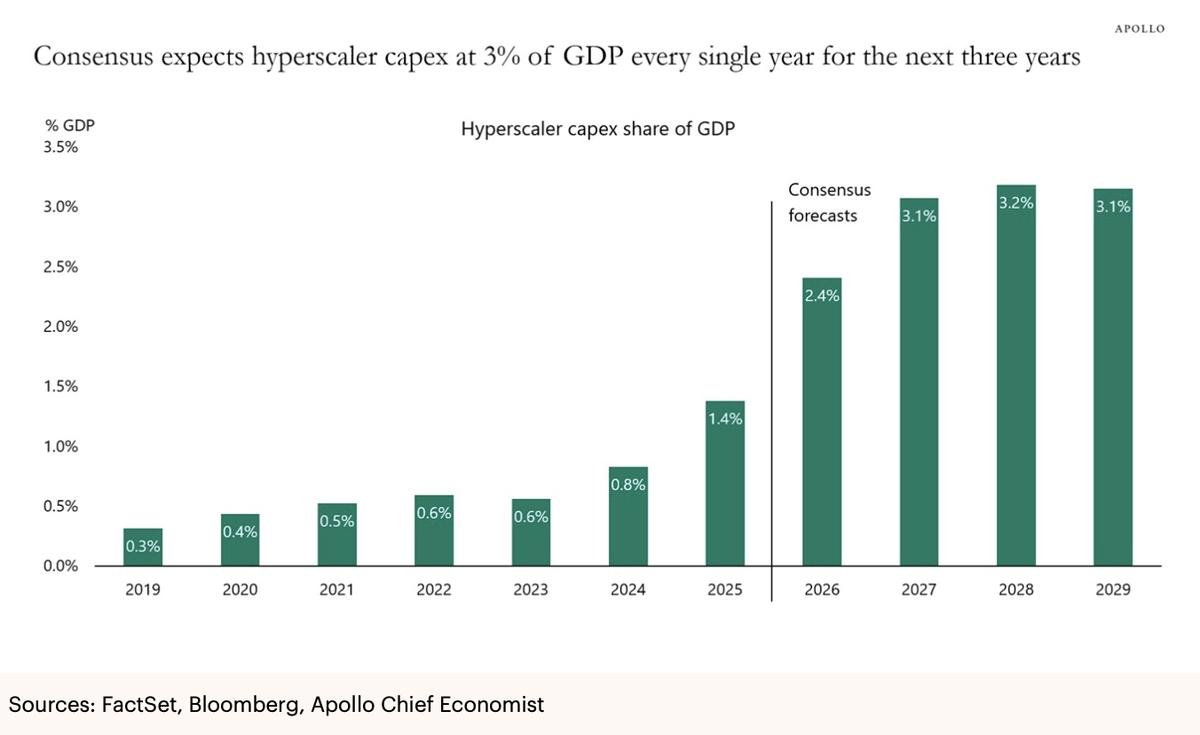
Analysts expect hyperscaler capex to sit at roughly three percent of GDP every single year through 2029. Five companies, Amazon, Meta, Oracle, Microsoft and Google, committing three cents of every dollar of American output, year after year, as the baseline case.
So...what does this mean if you're raising capital in this environment? Money moving into one trade at 0.85 points of GDP a year is money being pulled from everywhere else. Every founder outside the buildout is now competing with it for attention and for dollars. It is also worth looking at the right-hand side of the first chart. The orange bars show what housing did after its peak, falling from 6.6 percent of GDP to 3.5 by 2008. The green forecast bars simply stop in 2029. Nobody prints the down slope of their own forecast, which is exactly why the fastest capex cycle in modern American history deserves more respect than the consensus flat line suggests. ;)
Read Slok's full note at Apollo.
Sell Anything but Treasuries
Last week Japan spent an estimated 53 billion dollars in a single day defending the yen, likely the largest one-day currency intervention any country has ever run. The strange part is that the United States helped by selling euros rather than watching Japan sell down its trillion-dollar Treasury position, the largest foreign holding in the world.
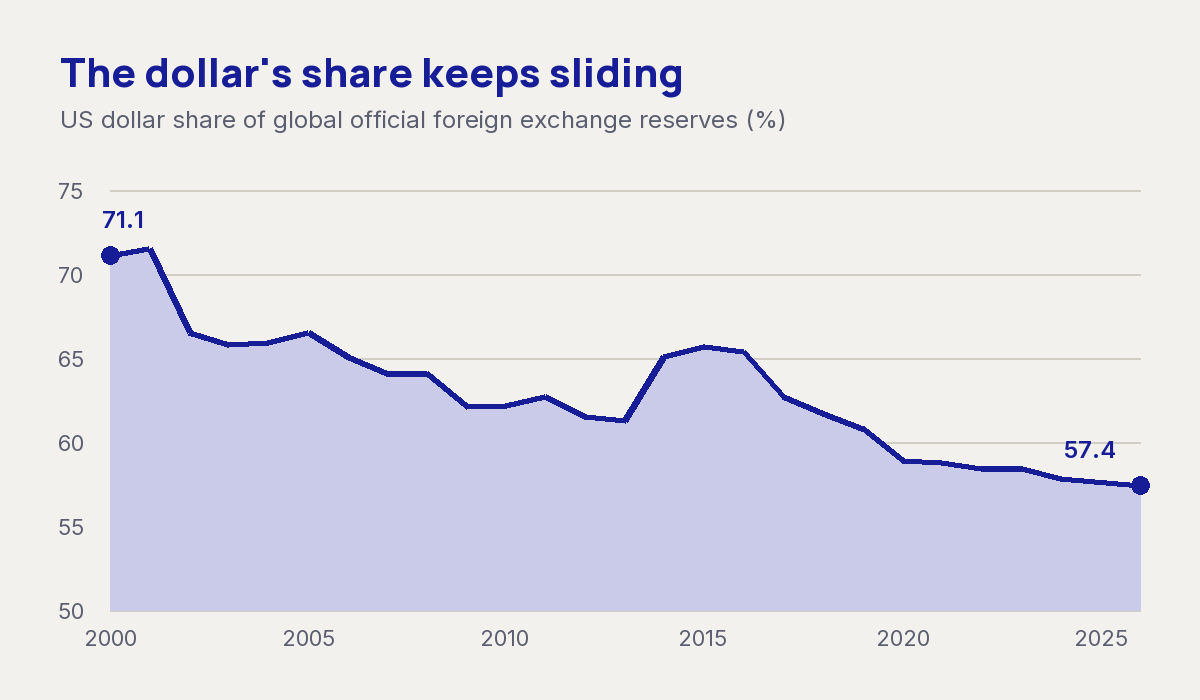
The chart above runs one direction for twenty-five years. In 2000 the dollar was 71 percent of the world's official reserves. Today it is about 57, and the line never once turned around.
I think Barry Eichengreen made one of the better points in the Financial Times: central banks hold Treasuries precisely because they can sell them whenever they need to, and the intervention showed that this is now true only up to a size. With the 10-year at 4.7 percent and the 30-year over five, America cannot afford to lose its biggest buyer, and it certainly cannot tolerate a big seller.
What this means for private markets? The money that used to sit passively in government paper keeps looking for somewhere productive to go. Private markets are one of the places it looks.
Two ways in
Raising, or know someone who is. Build a branded investor portal from the deck you already have, free, and keep the whole round. If someone you know is raising, forward them this issue. Start free.
Investing as an accredited investor. See what is live on the platform. Verification runs first, before any offering materials are available. Get started.
(Deal Box operates as a Title II matchmaking platform under the JOBS Act Section 201(c) exemption. We charge issuers for technology and advisory services and take no transaction fees from anyone. We are not a broker-dealer.)
One More Thing
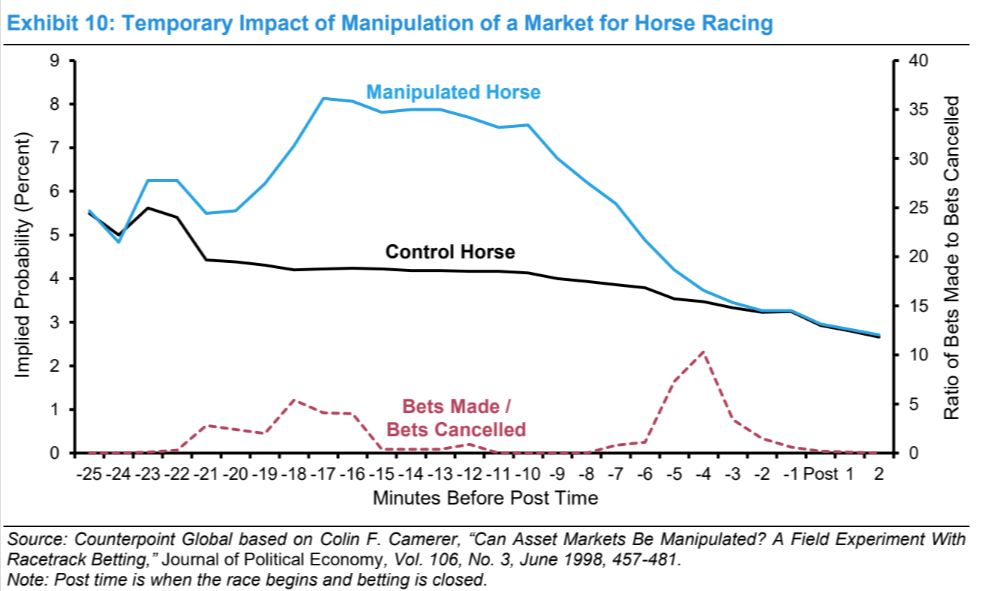
Michael Mauboussin and Dan Callahan at Morgan Stanley published a paper on the wisdom of crowds. The fun part is a real experiment: economist Colin Camerer went to an actual racetrack, placed large bets on a random horse, and canceled them at the last minute. While his fake money sat in the pool the odds bent, and the moment it left, the crowd pulled the price right back before the race went off. Thousands of strangers, no meeting, no memo, and they called his bluff in minutes.
Then comes the exception, courtesy of Steven Crist, the legendary handicapper: "the best friend that horseplayers have are the big race days." In plain English, a market is only as smart as the disagreement inside it. On Derby day the pool floods with people who bet once a year and pick horses the way they pick wine, by the prettiest name on the label, and the professionals quietly collect the difference. The crowd is wisest when it is diverse and deadliest when it is excited. Worth trying this on your family this weekend! ;)
The Latest in Private Markets
- SpaceX - the rumor got bought, the news got sold. SpaceX's first earnings call as a public company: revenue nearly doubled to 7.8 billion dollars, but capex came in at 18.4 billion against 13.2 expected, and the stock gave back 10.8 percent overnight after rising 9.4 into the print. Elon Musk's own description of the moon-robot manufacturing plan attached to that capex: "totally nuts." (Fortune)
- Oracle - credit keeps asking first. Oracle spent 82.6 percent of its revenue on capital expenditure last fiscal year, ran free cash flow of negative 23.7 billion dollars, and grew long-term debt from 76 to 125 billion, with another 248 billion of data-center leases not yet on the balance sheet. Five-year protection on its debt now costs more than protection on the junk-bond index. The equity is down roughly 60 percent since September. (Gavekal Research)
- AI - productivity is still in the future tense. San Francisco Fed researchers find that since early 2024, essentially all measured US productivity growth has come from working longer and running machines harder, not from working smarter. And the St. Louis Fed read 490,000 earnings call transcripts: 95 percent of executive statements about AI and productivity refer to expected future gains, not realized ones. (St. Louis Fed)
- Clarity Act - the bill that refuses to die. The Clarity Act, the bill that would finally define which digital assets are securities and which are commodities, missed its cloture window before the Senate recess, and Bitwise's Matt Hougan says it now lurches toward November in a walking dead state. Polymarket has the odds of passage this year at 27 percent, down from 82 in February. Meanwhile DTCC began production trades of tokenized stocks and Treasuries in July with about forty firms on board. Basically, the rails keep arriving ahead of the rules. (Bitwise)
A note from the desk
Deal Box was in USA Today two weeks ago. The announcement lays out the infrastructure strategy we have been building toward since 2016, across capital formation, identity, custody and settlement, and it is the most complete public statement of the thesis we have ever made.
More to come next Friday.
Best,
Thomas
At the desk | August 7, 2026

The Deal Box Dispatch is published weekly every Friday. Deal Box operates as a Title II matchmaking platform under the JOBS Act Section 201(c) exemption, with zero transaction fees. We are not a broker-dealer. We earn on technology and advisory services provided to issuers only. Nothing in this newsletter is a recommendation, solicitation, or offer to buy or sell any security.